
About hDrop
We built hDrop to make sweat visible.
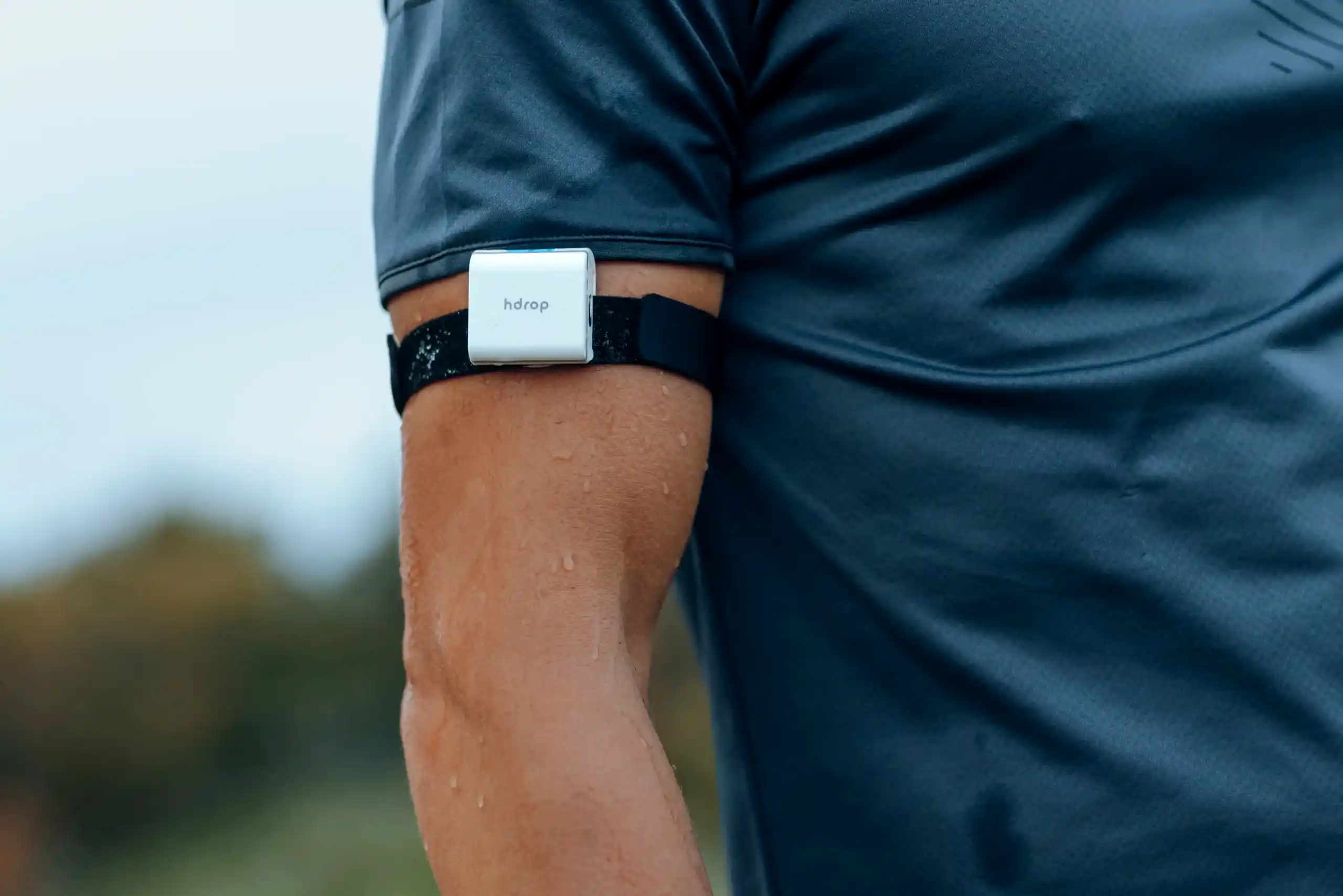
hDrop is a reusable wearable sweat sensor built in Arkansas to help athletes understand sweat rate, fluid loss and electrolyte loss during real exercise, with no disposable sensing patches.

The short version
hDrop began with a problem an athlete could feel, but could not measure.
In 2018, a mechanical engineering student and competitive tennis player started asking why hydration advice was so generic when athletes sweat so differently. The question became a senior engineering project, then hDrop.
hDrop Gen 1 launched on Kickstarter on November 26, 2020 with one principle that still defines the product today: the sensing surface should be reusable.
Read the full hDrop timelineA drop of sweat
The first version of hDrop was not a product. It was a question.
Adria Abella Villafranca came to the United States from Spain through competitive tennis. While studying mechanical engineering in Arkansas, long practices in the heat turned hydration into an engineering problem.
Could one small sensor turn sweat into information an athlete could use?
The idea became a senior engineering project. With Michael Cruz, the first carbon-electrode prototype proved it could distinguish salt concentration. From the beginning, one decision was clear: hDrop would not rely on a throwaway sensing patch.
The hDrop timeline
From two cups of water to a connected sweat-sensing platform.
hDrop grew step by step: prototype, patent, public launch, hand assembly, athlete feedback, Gen 2 and independent research.
A senior engineering project becomes the foundation of hDrop
Development begins with carbon electrodes, basic circuitry and early software. The prototypes are rough, but the sensing concept works.
hDrop Technologies is formed and its first patent family establishes priority
hDrop Technologies Inc. is founded and its first patent family establishes priority for wearable ion sensing and reusable electrodes.
View the hDrop patent recordA working hDrop wearable is documented before its consumer launch
VentureWell independently documents hDrop's wearable technology and plan to launch a consumer product in 2020.
Read the VentureWell profileThe original hDrop is publicly launched on Kickstarter
hDrop Gen 1 launches on November 26, 2020. The campaign reaches 249 backers and $26,903 in pledges, creating a public record of a fully reusable wearable sweat sensor with no disposable sensing patch.
Visit the original KickstarterEarly hDrop units are assembled on folding tables, one device at a time
Early production runs were assembled by hand in an apartment. Athletes using the device in real training became the team's fastest feedback loop.
hDrop receives U.S. Patent No. 11,523,775
U.S. Patent No. 11,523,775 covers wearable hydration and electrolyte monitoring using reusable electrodes, electronic sensing and wireless communication.
Read the patentA much smaller device carries the original reusable idea forward
hDrop announces Gen 2, a much smaller redesign led in part by Amine Mansouri. The form changes, but the core principle remains: no disposable sweat patches.
Read the Gen 2 launch announcementhDrop grows from a single wearable into a connected sweat-data platform
hDrop Gen 2 connects sweat data with the devices and platforms athletes already use. Independent academic work has now evaluated the system during running and cycling in the heat.
Explore hDrop integrationsThe first fully reusable consumer sweat sensor, by the public record we have identified.
hDrop Gen 1 launched on November 26, 2020 with reusable skin-contact electrodes and no disposable sensing patch or per-workout sensing consumable.
Based on the contemporaneous public record we have identified, it is the earliest fully reusable consumer sweat sensor offered to athletes. The claim is about commercialization, not the invention of sweat science.
Bootstrapped by design
hDrop was not handed a finished playbook. The team wrote one while building the product.
Early hDrop hardware was assembled by hand, while software, packaging and calibration methods changed constantly.
hDrop remains a small, engineering-led company, close enough to both the technology and the athletes to keep improving the product quickly.

Reusable from day one
Reusability was never an accessory. It was the product idea.
A reusable sensor lets athletes compare sweat data across heat, intensity and training conditions instead of relying on a single snapshot.
hDrop's direct-contact electrodes stay with the device, so the sensor can be used again and again.
hDrop today
One small sensor. A much bigger view of an athlete's sweat.
hDrop Gen 2 combines reusable sensing, algorithms, mobile software and sports-device integrations. It is a fitness product, not a medical device.
Direct contact with sweat
Reusable electrodes detect the local sweat signal at the upper arm during exercise.
Turn a local signal into useful estimates
Proprietary algorithms estimate sweat rate, fluid loss, sweat sodium concentration and electrolyte loss.
Put the data where athletes already train
hDrop connects with its mobile apps and supported sports watches, cycling computers and training platforms.
The people behind hDrop
Small team. Wide skill set. One product built end to end.
hDrop combines mechanical engineering, electronics, software, research and athlete support in one small team.
Sources and records
The hDrop story is documented.
Independent and primary records documenting hDrop's origin, launch and technology.
The hDrop story is still being written.
Explore the current sensor and the science behind it.